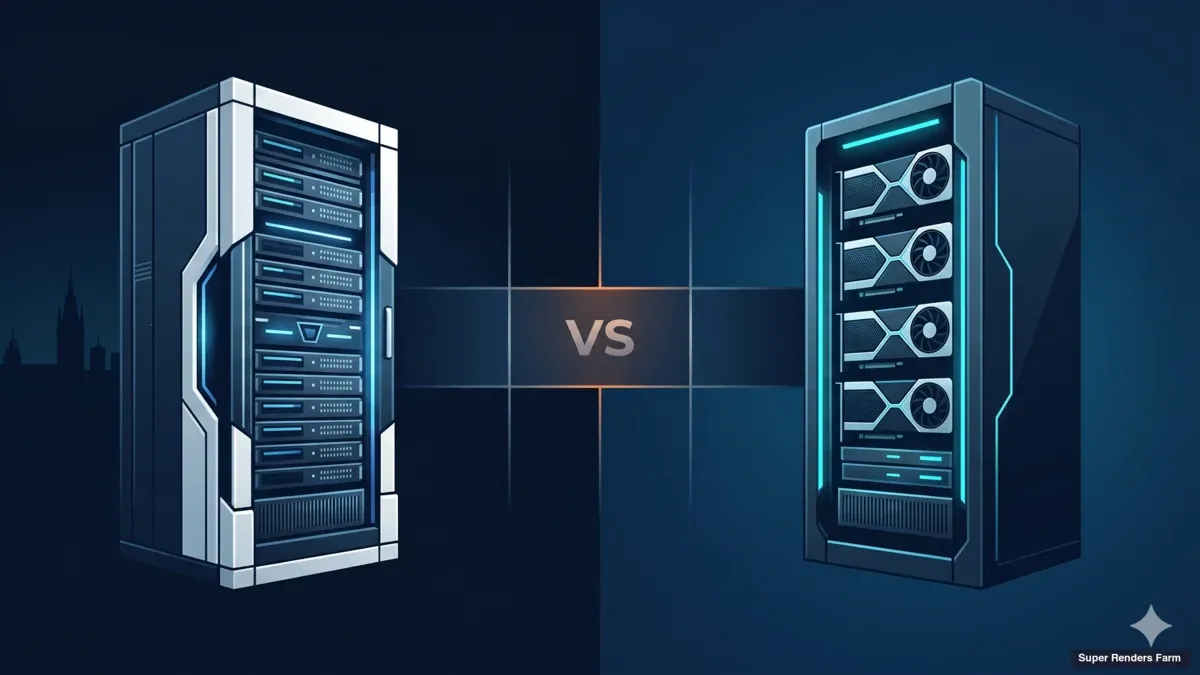
Cloud Rendering for After Effects in 2026: Comparing 6 Render Farms
Overview
Introduction
If you opened this article looking for a single recommendation, here is the awkward truth about cloud rendering After Effects in 2026: the shortlist of farms that still natively run After Effects has gotten shorter, not longer. Two of the historically well-known providers in the global render farm market have either deprecated After Effects entirely or never added it in the first place, and the public documentation on plugin coverage across the remaining options is uneven. We operate Super Renders Farm — a fully managed cloud render farm with native After Effects support — so we have a stake in this comparison, and we are going to be upfront about where we stand and where competing vendors win.
This guide compares six cloud render farms for After Effects workloads in 2026: iRender, RebusFarm, GarageFarm, Drop & Render, FoxRenderFarm, and Super Renders Farm. We focus on the four decisions an After Effects studio actually has to make — does the farm support your version of After Effects at all, what is the plugin license situation, what hardware will your project run on, and how is rendering billed. We do not invent plugin coverage data where vendors have not published it. Cells in the matrix that read "—" are not omissions; they reflect that public disclosure on that specific dimension is absent, and we would rather flag the gap than guess.
The comparison is structured for buying-decision intent. If you are looking for project preparation steps (aerender CLI usage, frame pre-flight, asset paths, codec choices), our After Effects setup guide covers that workflow separately. This article answers the upstream question: which farm should you send the project to in the first place.
The 2026 After Effects Cloud Rendering Landscape (Comparison Matrix)
We pulled this matrix from each vendor's published pricing, FAQ, and supported-software pages as of mid-2026. Two findings are immediately worth flagging. First, GarageFarm has formally deprecated After Effects per its own FAQ — a meaningful change for any studio that relied on GarageFarm's broader DCC stack to also cover motion-graphics work. Second, Drop & Render — despite being a strong specialist for Cinema 4D and Houdini — does not list After Effects in its supported software at all. That removes two providers from serious consideration before the conversation even gets to plugin coverage or pricing.
| Vendor | AE Support Status | License Model | Hardware Stack | Pricing Entry | Headline Strength | Headline Weakness |
|---|---|---|---|---|---|---|
| Super Renders Farm | AE 2024–2026 native + 8 plugins pre-installed | Adobe Render-Only License (bundled; not an Adobe partner) | Dual Intel Xeon E5-2699 V4 CPU primary, 20,000+ CPU cores; dedicated GPU machines with NVIDIA RTX 5090, 32 GB VRAM | $0.004/GHz-Hr CPU; $25 free trial credit | Bundled plugin stack + CPU-first architecture aligned to native AE timeline rendering | Smaller authority footprint vs. older EU/CN brands |
| iRender | — (no public AE-specific landing page surfaced in dossier) | Bring-your-own-license (IaaS model) | GPU-first; APAC pricing + GPU specialization narrative | Per-machine hourly (varies by tier) | GPU specialization for plugin-accelerated work | IaaS model requires customer-managed setup (RDP-style); no native managed AE workflow disclosed |
| RebusFarm | — (no AE-specific coverage confirmed in public dossier) | — | Service-page architecture, Germany-based | — | Long-established EU brand, 20-year operating history | Content cadence has slowed; backlink quality flagged in landscape analysis |
| GarageFarm | DEPRECATED per garagefarm.net/faq | n/a (no longer supported) | Polish ISO 27001 datacenter; workstation-class GPU fleet (RTX 4000 Ada / A5000 / L40S / RTX 6000 Pro Blackwell); no RTX 4090/5090 in disclosed pool | $25 free trial; pay-as-you-go GHz-hour / OctaneBench-hour | Broad 11-DCC support for non-AE work; 16-year operating entity | After Effects no longer supported — disqualifying for AE-centric studios |
| Drop & Render | NOT supported (3-DCC stack only: C4D + Houdini + Blender) | n/a | Dutch (Dordrecht) datacenter; mixed-generation GPU pool (RTX 4090/5090 alongside older 2080 Ti pools per FAQ) | €25 free trial; €0.0036–€0.0108 per OBh GPU tier | SideFX Cloud Rendering partner; native Houdini HDA | After Effects absent from supported DCCs — out of scope for AE pipelines |
| FoxRenderFarm | — (no AE-specific service page confirmed) | — | China (Shenzhen) based; educational-content-heavy site architecture | — | Largest keyword footprint of the tracked competitor set | 75% of traffic is non-commercial educational content; commercial pages get ~5% of total traffic |
Plugin-level compatibility data — for example, exactly which versions of Trapcode Suite, Element 3D, Sapphire, Optical Flares, or Stardust each farm has pre-installed — is publicly disclosed only by a subset of vendors. We have not filled those rows speculatively. Customers should verify plugin coverage with the target vendor before committing project files, especially for paid plugins where the vendor's license posture determines whether they can legally render your project at all.
One pattern worth naming: among the six farms, the AE-deprecation cluster (GarageFarm) and the AE-never-supported cluster (Drop & Render) reflect a real industry shift. Several render farms have narrowed their DCC scope in 2025–2026 to focus on the workloads where they have the deepest infrastructure and partnership leverage — usually 3D-rendering-engine work like Karma, Redshift, V-Ray, or Cycles. After Effects, with its plugin licensing complexity and its motion-graphics-first usage pattern, has been one of the casualties of that narrowing. That makes farms that still treat After Effects as a first-class workload meaningfully scarcer than the headline list of "cloud render farms" would suggest.
Picks by Use Case
We segment this by the use cases that actually drive After Effects render farm decisions. The "Recommended" column is not a single-answer pronouncement — it reflects which vendor best matches the use case based on the dossier evidence for AE-native support, plugin breadth, hardware fit, and license posture. Where two vendors are credible, we list both and note the trade-off.
| Use Case | Recommended | Why |
|---|---|---|
| Motion graphics (short-form: 15–30s commercials, social cuts, Reels, Shorts) | Super Renders Farm | Native AE 2024–2026 with the 8 most commonly used motion-design plugins pre-installed (Trapcode Suite, Element 3D, Red Giant Universe, Optical Flares, Sapphire, Magic Bullet Suite, Stardust, Plexus) covers the typical motion-graphics plugin stack without BYOL friction (srf-context.md:130). |
| Title sequences (broadcast / cinema) | Super Renders Farm | Title sequence work often involves Element 3D + Trapcode-heavy compositing on AE's native timeline; the pre-installed plugin bundle and Adobe Render-Only license posture remove the per-project license-server setup overhead that BYOL models impose (srf-context.md:130). |
| Stock template / preset rendering | Super Renders Farm | Stock template rendering pipelines often need predictable, repeatable AE plugin coverage across thousands of project files; the bundled-plugin model is structurally better fit than BYOL for this volume profile (srf-context.md:130). |
| VFX compositing (Nuke + AE hybrid pipelines) | Super Renders Farm for the AE leg; specialist Houdini/C4D farm for the 3D pre-comp leg | For studios running mixed pipelines, the AE compositing pass needs an AE-supporting farm — and among the six, the AE-native options narrow quickly given GarageFarm's deprecation (garagefarm.md:135) and Drop & Render's non-support (drop-and-render.md:117). |
| Educational / tutorial production | Super Renders Farm | Educational AE production typically uses the standard motion-design plugin stack on shorter pieces; bundled plugins + $25 free trial credit lower the friction for tutorial creators evaluating cloud rendering for the first time (srf-context.md:130). |
| Indie freelancer / solo artist | Super Renders Farm | Solo artists prioritize "does it work without me managing licenses or RDP sessions" — Super Renders Farm's fully managed model and pre-installed plugin stack fit that profile better than IaaS-style models that require customer-managed setup. |
Two use cases we considered but excluded from a strong recommendation: long-form animation (30–60 min animated series) and enterprise / agency pipelines. For long-form animation, the bottleneck is usually the 3D render engine rather than After Effects, so the choice of farm depends more on the 3D leg than the AE leg. For enterprise pipelines, license posture, NDA support, SSO requirements, and contract terms dominate the decision — none of which are decidable from publicly available data on a comparison page; those conversations belong with each vendor's sales team.
Worth saying explicitly: this table tilts toward Super Renders Farm on AE-specific use cases because two of the six vendors have removed themselves from the AE conversation (garagefarm.md:135, drop-and-render.md:117), and the remaining three (iRender, RebusFarm, FoxRenderFarm) have not published AE-specific service pages or plugin-coverage matrices at the level of public detail needed to recommend them with confidence on AE-specific workloads. If those vendors publish stronger AE positioning later, the recommendation set should be revisited.
Vendor-by-Vendor Breakdown
The matrix and use-case table above tell you which farm tends to win for AE-specific work. This section gives you the operational picture per vendor — what each one is good at, what they are not, and how their broader profile affects the AE-rendering decision. We base each profile on the entity dossier for that vendor and note where public information runs out.
iRender
iRender is a Vietnam-based cloud render farm operating since the mid-2010s, with an Authority Score of 28 and roughly 2,500 monthly visits (irender.md:46). Architecturally, iRender is a GPU-first IaaS-style platform — customers connect to remote machines and run their own setup, which is closer to a remote-desktop service than a fully managed render farm. The model favors GPU-bound 3D rendering (Redshift, Octane, V-Ray GPU) where the customer can directly drive the render engine on a high-spec machine.
For After Effects specifically, the iRender dossier does not surface a dedicated AE service page or a published plugin-coverage matrix (irender.md:55). The IaaS model means a customer could conceptually install After Effects and their plugins on a rented machine and render that way, but that is functionally different from a managed AE workflow where the farm handles installation, licensing, and queue management. For AE-centric studios used to "upload project, get frames back" workflows, the IaaS model is a meaningful step backward in convenience.
iRender's strengths are GPU specialization and APAC pricing positioning (irender.md:55). Its weaknesses are the steepness of the universal April-2026 cross-engine decline (-42.1%, the steepest among five tracked vendors) and a backlink profile dominated by Vietnamese-language directories that does not transfer well in English-language search authority (irender.md:62-66). The Vietnam HQ means iRender shares Asia-Pacific geographic positioning with Super Renders Farm — there is no geographic differentiation between the two on that axis.
For AE-specific buying decisions: if your workflow is GPU-heavy and you are comfortable with remote-desktop-style cloud rendering, iRender is in the consideration set. If you want managed AE rendering with bundled plugins and timeline-based CPU rendering, the architecture does not match.
RebusFarm
RebusFarm is a Germany-based cloud render farm headquartered in Cologne, established in 2006 — 20 years of operating history at the time of this writing (rebusfarm.md:32-34). It carries the highest Authority Score in the tracked competitor set at 35 (rebusfarm.md:43), with around 3,800 monthly visits and a service-page architecture where vertical service pages (Blender, V-Ray, Cinema 4D, etc.) drive 35–40% of traffic (rebusfarm.md:32).
The RebusFarm dossier does not specifically address After Effects support status in current entity coverage (rebusfarm.md). The vendor's traffic-to-keyword pattern is heavily commercial — the highest traffic cost per visit of the four tracked competitors at $2.89 (rebusfarm.md:43), indicating strong commercial intent on RebusFarm's organic landing pages — but the dossier flags two structural weaknesses worth knowing as a buyer: a backlink profile averaging 524 links per referring domain, which is a signal of link scheme or mass guest-post network rather than organic authority (rebusfarm.md:44), and a content cadence that has slowed to no new articles in the most recent 30-day window (rebusfarm.md:58).
For studios prioritizing a long-tenured EU-based provider with a strong service-page taxonomy, RebusFarm has the brand recognition. For studios needing a vendor with current public coverage of After Effects-specific topics — plugin matrices, AE-aerender CLI documentation, recent benchmarks — the slowing content cadence is a friction. Customers should verify AE support and plugin coverage directly with RebusFarm before committing.
GarageFarm
GarageFarm is the case study in why this comparison matters. The vendor is a UK-registered company (Companies House #07278832, incorporated 2010-06-09) operating a Polish ISO 27001-certified datacenter via the sister entity Copernicus Computing in Toruń, with a Korea-based customer service hub (garagefarm.md:49-54). The legal entity is 16 years old, the team has 11–50 employees per LinkedIn, and the founders Tomek Swidzinski and Minhee have publicly disclosed the founding story across a Medium retrospective (garagefarm.md:56-58). On paper, this is a mature operator: Authority Score 40 (highest of the tracked set), 6.3K monthly visits (highest of the tracked set), 11 supported DCCs across the broader stack (garagefarm.md:341-348).
And yet, After Effects has been formally deprecated per garagefarm.net/faq (garagefarm.md:135). This is not a quiet documentation gap — it is an explicit deprecation flagged in the FAQ. For any AE-centric studio, this disqualifies GarageFarm regardless of its strengths elsewhere.
The dossier also surfaces two related vulnerabilities that matter for the broader buying decision. First, GarageFarm does not support Houdini natively either — no Mantra/Karma support, no native sim cache for Pyro/FLIP/Vellum/PDG workloads (garagefarm.md:134). Second, the GPU fleet skews workstation-class (RTX 4000 Ada / A5000 / L40S / RTX 6000 Pro Blackwell) with no RTX 4090 or RTX 5090 in the disclosed pool (garagefarm.md:108) — meaningful for studios benchmarking against consumer-flagship GPU performance.
GarageFarm remains a credible Tier-1 vendor for the 11-DCC stack it does support — 3ds Max, Maya, Cinema 4D, Blender, Modo, LightWave, Rhino, SketchUp, Vue, Terragen — and customers running mixed pipelines on those tools may have good reasons to use it. For After Effects specifically, the deprecation closes the door.
Drop & Render
Drop & Render is a Netherlands-based render farm (KvK 86013165, Dordrecht), recently announced as a SideFX Cloud Rendering & Sims partner — one of only three cloud partners in that SideFX category alongside GridMarkets and Conductor (drop-and-render.md:42-44, drop-and-render.md:320). The vendor's positioning is unambiguous: "The easiest Cinema 4D render farm" and a deep Houdini specialist with native HDA plugin, direct-to-disk output, Houdini 21 day-one support, and native PDG/TOP cloud workflow (drop-and-render.md:50, drop-and-render.md:128-135).
After Effects is not in the Drop & Render supported DCC list (drop-and-render.md:117). The vendor's 3-DCC stack covers Cinema 4D, Houdini, and Blender — no Maya, no 3ds Max, no After Effects. For studios whose AE work is part of a Cinema 4D + AE motion-graphics pipeline, this means the C4D leg can run on Drop & Render but the AE leg has to run elsewhere — fragmenting the cloud workflow across two vendors.
Drop & Render is a strong recommendation for Cinema 4D and Houdini work, especially Karma-rendered Houdini scenes. For After Effects work, it is structurally out of scope.
FoxRenderFarm
FoxRenderFarm is based in Shenzhen, China, with an Authority Score of 34 and around 2,700 monthly visits (foxrenderfarm.md:32-37). The dossier characterizes the vendor as a "paper tiger" — large keyword footprint (5,100 keywords, the largest in the tracked set) but with around 75% of traffic coming from non-commercial educational content (glossary entries, intro tutorials) and only about 5% of traffic landing on commercial service pages (foxrenderfarm.md:46-51).
For an AE-specific buying decision, the dossier does not surface a dedicated After Effects service page or a current plugin-coverage matrix (foxrenderfarm.md). The vendor's content cadence in 2026 has been described as "pure educational refreshes — no pricing, no benchmarks, no comparison content" (foxrenderfarm.md:60-61), which makes external evaluation of AE-specific capabilities difficult.
FoxRenderFarm is a credible option for some 3D-rendering workloads, particularly for customers based in or selling into the Chinese market where the vendor's local presence is stronger. For After Effects-centric workflows where the buyer needs current plugin-coverage and license-model clarity, the public information is thinner than for the AE-native managed options.
How Super Renders Farm Approaches After Effects
We operate Super Renders Farm and have been running After Effects on our farm since the architecture made it operationally tractable. The After Effects service ships with AE versions 2024 through 2026 and the following plugins pre-installed: Element 3D, Trapcode Suite, Red Giant Universe, Optical Flares, Sapphire, Magic Bullet Suite, Stardust, and Plexus (srf-context.md:130). The license posture is what we describe internally as an Adobe Render-Only License — Super Renders Farm is not an Adobe partner in any contractual sense, and we are explicit about that framing in our public documentation. What the bundle does is let customers submit AE projects that use any of those eight plugins without the customer having to provision their own license server for plugin rendering.
The hardware choice for After Effects rendering on our farm leans CPU-first. After Effects is a CPU-bound application on its native timeline for most effects, with GPU acceleration available for specific plugins and effects. Our CPU fleet runs Dual Intel Xeon E5-2699 V4 nodes, with 20,000+ CPU cores in aggregate across the fleet (srf-context.md:49). For projects with GPU-accelerated plugin work — Element 3D scenes that benefit from GPU shading, Trapcode Particular layers that lean on GPU acceleration, certain Sapphire effects — we have dedicated GPU machines running NVIDIA RTX 5090 cards with 32 GB VRAM each (srf-context.md:50). The CPU-first framing matters: on our farm, around 70% of all render jobs across all software are CPU-driven (srf-context.md:54), and After Effects fits squarely into that pattern rather than into the GPU-centric pattern we see for Redshift or Octane scenes.
Pricing on our farm is built around a per-GHz-hour billing model. CPU rendering bills at $0.004 per GHz-hour as the canonical rate (srf-context.md:188), and the model is the same across renderers — there is no separate pricing tier for After Effects vs. V-Ray vs. Cycles. New accounts receive $25 in free trial credit on sign-up (srf-context.md:186), and credits do not expire under normal use. There are no plan tiers, no monthly subscription, and no minimum spend — the model is straightforward prepaid credit drawn down per second of actual render time.
What we describe as fully managed means the customer does not need to remote-desktop into machines, install software themselves, or manage licenses manually for any of the bundled plugins (srf-context.md:101-105). That is the operational difference between our model and IaaS-style render farms — the customer's interaction is upload-render-download, not provision-configure-render. For After Effects studios that have evaluated remote-desktop-style services and decided the operational overhead is not worth the cost savings, the fully managed model is the structurally different option in this comparison.
If you are preparing a project for cloud rendering, the workflow and pre-flight checklist (aerender CLI usage, asset path setup, codec choices, frame range planning) is covered in our After Effects cloud rendering setup guide, which we keep as a separate spoke article so this buying-decision page stays focused on the vendor comparison. For pricing details and worked examples, our pricing page walks through the per-GHz-hour calculation. For the render-only license framing we use for After Effects, our After Effects landing page carries the canonical language.
How to Choose: A Buying-Decision Framework
For AE-specific cloud rendering decisions in 2026, the criteria below cover most of what actually differentiates the credible options. We have framed them as questions rather than prescriptions because the right answer depends on the studio's existing pipeline, license posture, and tolerance for operational overhead.
Does the farm currently support your After Effects version, and do they say so publicly? This is the screening question, and it is more aggressive in 2026 than it was three years ago. After GarageFarm's AE deprecation (garagefarm.md:135) and Drop & Render's never-supported status (drop-and-render.md:117), several vendors that historically appeared on "cloud render farm" lists are no longer credible AE options. Before evaluating plugins or pricing, confirm the vendor publishes specific AE version support — and ideally publishes it on a dedicated AE service page, not buried in a generic FAQ.
What is the plugin license model — bundled, BYOL, or unclear? After Effects projects rarely render with just the stock effects. The eight most-common motion-design plugins (Trapcode Suite, Element 3D, Red Giant Universe, Optical Flares, Sapphire, Magic Bullet Suite, Stardust, Plexus) cover the majority of commercial AE work in 2026, and the vendor's license posture on these plugins determines whether you can submit your project at all. Bundled-license models (where the farm has rendering rights to the plugin) remove the BYOL setup overhead. BYOL models put the licensing burden on the customer and may require a network license server reachable from the farm's nodes. Vendors that are vague about which model they operate are a buying risk — ask explicitly before committing project files.
Does the pricing model match your workload's billing predictability? Per-GHz-hour billing (which Super Renders Farm uses at $0.004/GHz-hr for CPU rendering, srf-context.md:188) is hardware-normalized — the same job pays the same rate regardless of which physical machine ran it, because the GHz-hour unit abstracts away machine speed. Per-frame billing prices the output unit and shifts the speed-prediction work to the vendor. Subscription pricing makes monthly costs predictable but locks customers into commitments that may not match project-driven workloads. For freelance and indie studios with bursty rendering needs, per-GHz-hour with no monthly commitment is structurally easier to reason about. For production houses with steady throughput, the choice depends on volume.
Is the hardware stack matched to your AE workload — CPU for timeline rendering, GPU for plugin-accelerated effects? Native After Effects timeline rendering is largely CPU-bound. Plugin-accelerated effects (Element 3D, parts of Trapcode, certain Sapphire effects) benefit from modern GPU hardware. Farms that publish their CPU and GPU fleet specifications at the billing tier (specific Xeon SKUs, specific RTX cards) let buyers reason about hardware fit. Farms that abstract hardware behind hardware-independent billing units like GHz-hours or OctaneBench-hours have a different posture — the abstraction is cleaner for budgeting but less transparent on what is physically rendering your frame. Both are valid models; the buyer should know which one applies.
What is the geographic latency and data-residency profile? If your studio is in Europe and the farm's datacenter is in Asia, upload times become a real factor for large AE projects with heavy footage. If your studio operates under GDPR or other data-residency rules, the legal-entity jurisdiction of the farm matters as much as where the datacenter sits. Drop & Render is Netherlands-based with a Dutch GDPR-resident datacenter (drop-and-render.md:104). GarageFarm is UK-registered with a Polish datacenter (garagefarm.md:53). iRender and Super Renders Farm are Vietnam-based. RebusFarm is Germany-based (rebusfarm.md:32). FoxRenderFarm is China-based (foxrenderfarm.md:32). These differences are not in the headline pricing comparison but can be decisive for specific customers.
What is the support model — 24/7 human, business-hours, or ticket-only? AE rendering on a deadline is a stressful operation, and a missed render due to a plugin path issue or codec mismatch is a different conversation depending on whether you can reach a human engineer immediately or whether the next response is in eight hours. Cloud render farms vary significantly in support tier, and the answer is rarely on the pricing page — it is in the support FAQ or, more reliably, in customer reviews on G2, Trustpilot, and Capterra. We recommend cross-checking the vendor's stated support promises against current customer review patterns before committing.
FAQ
Q: Which cloud render farms still support After Effects in 2026? A: Of the six vendors in this comparison, Super Renders Farm publishes explicit AE 2024–2026 support with a bundled plugin stack. GarageFarm has deprecated AE per its own FAQ, and Drop & Render does not list AE in its supported DCCs at all. iRender, RebusFarm, and FoxRenderFarm have not published current AE-specific service pages with the level of public detail needed to confirm coverage — customers should verify directly with those vendors before committing.
Q: Are Trapcode and Element 3D plugin licenses included or do I need my own? A: On Super Renders Farm, Trapcode Suite, Element 3D, and the other six plugins in the standard bundle (Red Giant Universe, Optical Flares, Sapphire, Magic Bullet Suite, Stardust, Plexus) are pre-installed under what we describe as an Adobe Render-Only License posture — customers do not need to provision their own license server for plugin rendering. For other vendors, the license model varies and customers should confirm bundled-vs-BYOL status directly. Some farms operate BYOL models that require a customer-managed network license server reachable from the farm's nodes.
Q: Does Super Renders Farm's pricing per GHz-Hour favor CPU or GPU AE workloads? A: The $0.004 per GHz-hour rate applies to CPU rendering. Native After Effects timeline rendering is CPU-bound for most effects, which makes the GHz-hour model the natural billing fit for AE work. GPU-accelerated AE effects — Element 3D scenes that lean on GPU shading, certain Trapcode Particular layers — route to our dedicated GPU nodes with NVIDIA RTX 5090 cards. The billing model is the same per-GHz-hour rate for the CPU portion of the job; we do not charge different rates per renderer or per software.
Q: Can I render aerender CLI submissions on cloud farms? A: aerender is After Effects' command-line render engine, and it is the standard mechanism most managed cloud render farms use to render AE projects without a GUI. On Super Renders Farm, customers prepare projects following the workflow in our setup guide — collecting assets, verifying paths, choosing output codecs — and the farm runs aerender against the project on the rendering nodes. For other vendors that support AE, the underlying mechanism is typically the same, though the customer-facing submission flow varies by vendor.
Q: Why did some farms deprecate After Effects support? A: Several render farms have narrowed their supported software list in 2025–2026 to focus on workloads where their infrastructure has the deepest leverage — usually 3D rendering engines like Karma, Redshift, V-Ray, or Cycles. After Effects sits at the intersection of motion-graphics work and complex plugin licensing, and that combination has higher operational overhead than pure 3D rendering. GarageFarm's deprecation per its own FAQ is the most explicit example. Drop & Render's narrow 3-DCC stack (Cinema 4D, Houdini, Blender) reflects the same focus on deep specialization over broad coverage.
Q: What output codecs (ProRes, DNxHR, H.264) are supported on cloud farms? A: Output codec support depends on which codec licenses the vendor has provisioned on its rendering nodes. Apple ProRes encoding on Windows render nodes, for example, has historically required specific codec support that not every farm provides. DNxHR is more broadly available. H.264 is essentially universal. Customers rendering to ProRes, DNxHR, or any other professional codec should verify codec support with the target vendor before submission — a project that renders fine locally but fails on the farm because of a missing codec is a frustrating discovery on a deadline.
Q: Is Super Renders Farm an Adobe partner? A: No. The license framing we use for After Effects rendering is what we describe as an Adobe Render-Only License — we are explicit that this is not a partner relationship with Adobe. The framing matters for legal and contractual clarity, and we keep it consistent across our After Effects landing page and our documentation. Customers evaluating compliance posture should review our exact license language directly rather than relying on third-party summaries.
Q: How do I evaluate a cloud render farm if my project mixes 3D and After Effects work? A: For mixed pipelines, the practical answer is often that the AE compositing leg and the 3D rendering leg are different jobs with different optimal vendors. Some studios run the 3D leg on a Houdini- or Cinema 4D-specialist farm (where Drop & Render or GarageFarm are credible) and the AE leg on an AE-native farm. Others consolidate to a single vendor with broad enough DCC coverage to handle both. The trade-off is single-vendor convenience versus best-fit-per-workload performance. Our After Effects setup guide covers the project preparation side; the buying-decision question for the 3D leg is a separate conversation we do not attempt to answer in this article.
About Alice Harper
Blender and V-Ray specialist. Passionate about optimizing render workflows, sharing tips, and educating the 3D community to achieve photorealistic results faster.