
Cinema 4D 2027 Features Preview: What Maxon's 2026 Roadmap Signals
Overview
Introduction
As of mid-May 2026, Maxon has not officially announced Cinema 4D 2027. The version currently shipping on most desktops is Cinema 4D 2026.2, released April 15, 2026, paired with Redshift 2026.5. What we have to work with for a Cinema 4D 2027 preview, then, is not a feature list — it's a release pattern, a set of public roadmap statements from NAB 2026, and three coordinated 2026.x updates that show where Maxon's engineering attention has been spent.
We're writing this from the perspective of a team that runs Cinema 4D and Redshift jobs across a distributed render farm every day. The question we get from clients in the months before each annual Maxon release is the same: should we plan our pipeline around the new version, or should we wait? That decision depends less on what's marketed in the launch keynote and more on what's already visible in the previous cycle's release notes and at industry events like NAB. We'll walk through those signals here, then translate them into what they mean for studio pipelines, render farm compatibility, and migration planning.
Where we describe something as confirmed by Maxon, we cite the source. Where we describe something as a roadmap signal — a likely direction inferred from the 2026 cycle or public statements — we say so. Specific feature confirmation will arrive when Maxon publishes the 2027 release notes, on or around the typical September window.
Why a September 2026 release is the most likely window
Maxon has released a major Cinema 4D version every September for several years. Cinema 4D 2025.0 shipped on September 10, 2024, and Cinema 4D 2026.0 shipped on September 10, 2025. The earlier releases — Cinema 4D Release 18 and Release 20 — also landed in September of their respective years. That makes a Cinema 4D 2027 release in September 2026 the most probable scheduling assumption, with a December 2026 follow-up (2027.1) and an April 2027 secondary update (2027.2), matching the cadence we saw across the 2026 cycle.
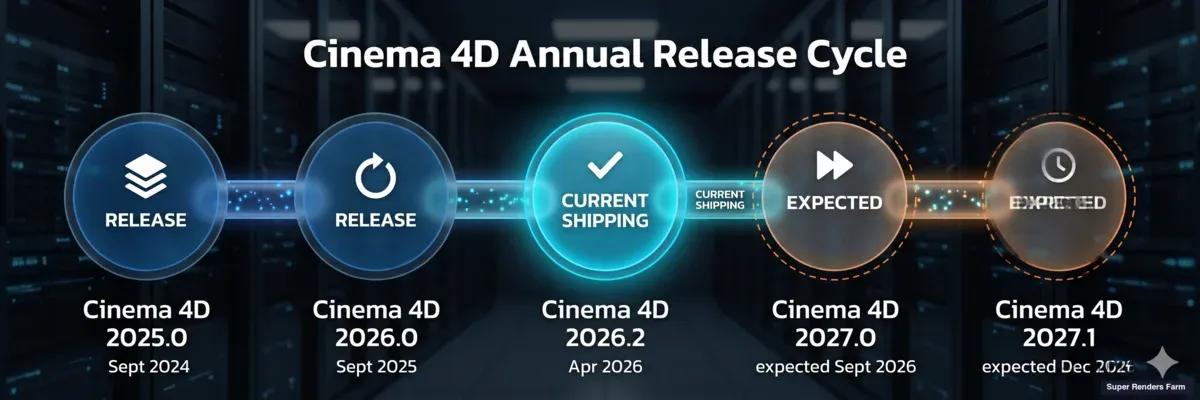
Cinema 4D annual September release cadence timeline showing 2025.0, 2026.0, 2026.2 current shipping, expected 2027.0, and expected 2027.1
Studios planning Q4 2026 production schedules around Cinema 4D should treat the September release as a likely cutover point. Render farms and renderer vendors typically need four to eight weeks after a stable Cinema 4D release before delivering compatible plugin builds, so the practical "Cinema 4D 2027 is production-ready" window for studios using Redshift, V-Ray, or other engines will land closer to November or December 2026 in most cases.
What Maxon has publicly confirmed for late 2026 and beyond
Three items from Maxon's 2026 public communications are not speculation. They have been announced and they will be relevant to Cinema 4D 2027's launch context.
Cinema 4D for iPad — commercial release in late 2026. Maxon unveiled the beta of Cinema 4D for iPad at NAB 2026 (April 18–22, 2026) and confirmed a commercial release window of "late 2026" (CG Channel, ProVideo Coalition). The minimum hardware is an iPad with an M2 processor; Maxon recommends an M3 or newer. This release will almost certainly coincide with or follow the Cinema 4D 2027 desktop launch, and the iPad and desktop versions are expected to share scene compatibility. For studios, the practical effect is that some scene preparation work — modeling roughs, blockouts, animation key passes — may shift to mobile, with the desktop version handling the heavier downstream work that ultimately reaches a render farm.
Redshift Live as the stated direction for interactive rendering. Redshift Live, introduced in Cinema 4D 2026.2 / Redshift 2026.5, replaces the older Redshift RT real-time engine. The release notes describe it as "a new real-time render engine for interactive previews," with faster connection times and smoother navigation in the Redshift Live Viewport IPR. The replacement of Redshift RT, rather than a parallel update to it, signals that Maxon is consolidating its interactive rendering work onto Redshift Live going forward. Continued evolution of Redshift Live — feature parity with offline Redshift, broader viewport-to-final-frame workflows — is the most predictable forward-direction signal from the 2026 cycle.
ARM-native support on Windows. Cinema 4D 2026.2 added native support for ARM processors on Windows, which improves performance and reduces memory usage on Copilot+ PCs running the Windows-on-Snapdragon platform (CG Channel). This is part of a broader cross-architecture maturity story: Cinema 4D has been Apple Silicon-native since 2022, the iPad version targets Apple's M-series chips, and Windows ARM is now in the matrix. Cinema 4D 2027 will inherit this support; whether it deepens (broader plugin compatibility on ARM Windows, performance refinements) is something to watch in the 2027.0 release notes.
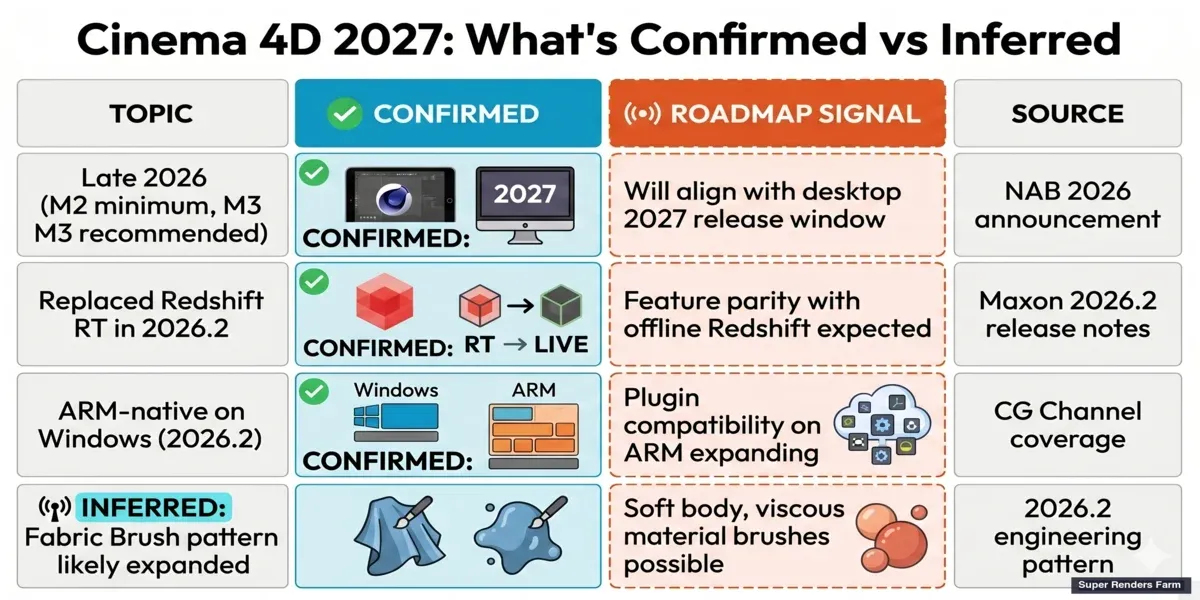
Cinema 4D 2027 confirmed Maxon announcements versus inferred roadmap signals — iPad commercial release, Redshift Live, ARM Windows confirmed; Fabric Brush evolution and other 2026 cycle engineering signals inferred
Where the 2026 cycle's engineering work points for 2027
Reading the Cinema 4D 2026.0, 2026.1, and 2026.2 release notes side by side, four themes stand out. These are the areas where Maxon has been investing engineering effort across the cycle, and they're the most likely places where the 2027 release will continue building.
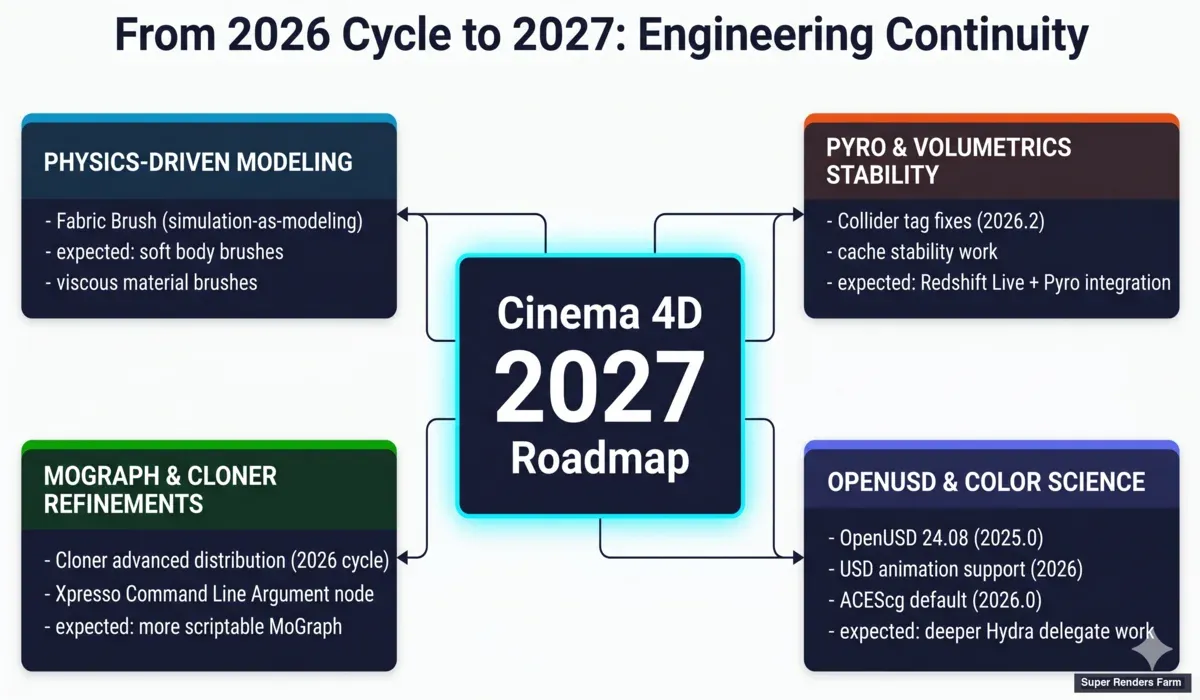
Four engineering themes from Cinema 4D 2026 cycle that signal Cinema 4D 2027 direction — physics-driven modeling, Pyro and volumetrics stability, MoGraph and Cloner refinements, OpenUSD and color science consolidation
Physics-driven modeling and simulation maturity. Cinema 4D 2026.2 introduced the Fabric Brush, an artist-friendly modeling tool powered by Cinema 4D's cloth simulation system. Fabric Brush is significant because it crosses a line: it's a modeling tool that uses a simulation engine under the hood, giving users physics-driven folds and draping without rigging or solver setup. This is the kind of feature that tends to expand in subsequent releases. We'd expect Cinema 4D 2027 to broaden the brush-as-simulation pattern to other physical phenomena — soft bodies, viscous materials, or hair-and-fur grooming through a similar interactive paradigm. None of this is confirmed, but the engineering pattern is visible.
Pyro and volumetrics stability. The 2026.2 release fixed a viewport freeze caused by Pyro with the Collider tag, and resolved a crash when caching specific Pyro setups. The presence of these fixes — and the iterative bug-resolution pattern across 2026.1.1 through 2026.1.4 — tells us volumetric simulation is being hardened for broader production use. Cinema 4D 2027 will likely continue this work, particularly around Pyro's performance with the Redshift Live viewport and scene-level caching for distributed rendering. Improved Pyro caching matters for render farms: the more deterministic the cache, the cleaner the asset bundle a farm node receives.
MoGraph and Cloner refinements. The 2026 cycle expanded the Cloner with new advanced distribution options and added the Xpresso Command Line Argument node, which lets command-line render jobs pass string arguments into Xpresso setups. Both of these matter for studios automating MoGraph-heavy work through render farms. The Command Line Argument node is particularly useful for batch rendering where the same MoGraph template needs to be driven by different per-frame or per-shot parameters. We expect Cinema 4D 2027 to continue making MoGraph more scriptable and farm-friendly along this axis.
OpenUSD and color science consolidation. Cinema 4D 2025.0 updated the internal USD library to OpenUSD 24.08, and the 2026 cycle added USD support for character animation, joint hierarchies, skin weighting, animated cameras, and animated lights. ACEScg and OpenColorIO became the default working color pipeline in Cinema 4D 2026.0. These are infrastructure-layer improvements, and infrastructure improvements compound over multiple releases. Cinema 4D 2027 will almost certainly update the OpenUSD library version again, and we'd watch for deeper USD round-trip support — particularly around materials and Hydra render delegates — as well as continued ACEScg workflow refinements.
Redshift integration in Cinema 4D 2027
Redshift is now bundled with all Cinema 4D subscriptions, which makes the renderer integration roadmap effectively part of the Cinema 4D roadmap. Two threads from the 2026 cycle are worth tracking forward.
The first is Redshift Live's evolution, covered above. The replacement of Redshift RT consolidated Maxon's interactive-rendering work, and we expect 2027 to push feature parity between Redshift Live and the production renderer. Faster light editing, faster material updates, and tighter viewport IPR responsiveness are all natural next steps.
The second is lighting and Sun & Sky maturity. Cinema 4D 2026.2 added a night-sky option to the Redshift Sun & Sky system for realistic dusk-to-night lighting. This is part of a longer trajectory of physically-based environment lighting work, and we'd expect Cinema 4D 2027 to continue refining sky simulation, IES profile support, and HDRI workflows.
For studios planning Redshift production work on Cinema 4D 2027, the practical advice is to wait for an explicit 2027-compatible Redshift build before migrating render farm nodes. Plugin-style compatibility constraints apply to bundled renderers too: a Redshift build compiled against the Cinema 4D 2026 SDK will not load in 2027.
Pricing and Maxon One subscription context
We won't speculate about pricing changes for Cinema 4D 2027. Maxon has not communicated any pricing adjustments tied to a 2027 release, and the historical pattern is that major version bumps maintain the existing subscription model. What we can describe factually is the current structure: Maxon offers Cinema 4D as a standalone subscription and as part of Maxon One, which bundles Cinema 4D, Redshift, ZBrush, Red Giant, and Universe. Studios already on Maxon One should expect Cinema 4D 2027 to be included in the existing bundle at no extra cost.
If Maxon changes pricing for the 2027 release, that will be communicated in the release announcement. Until then, plan based on current pricing. [RICHARD: cần confirm if SRF needs to make any pricing-related statement before official Maxon announcement.]
Migration considerations from Cinema 4D 2026 to 2027
The migration pattern from 2026 to 2027 will most likely mirror the 2025-to-2026 path. Three areas warrant planning before a production cutover.
Plugin and renderer compatibility. Third-party renderers and plugins compile against specific Cinema 4D SDK versions. Redshift, Octane, Arnold for Cinema 4D, and the wider plugin ecosystem will all need 2027-compatible builds before they will load in the new version. Based on historical patterns, beta builds typically appear within two to six weeks of a stable Cinema 4D release, with production-ready builds following one to three months later. Studios should not expect to run Redshift or Octane scenes on Cinema 4D 2027 immediately at launch; plan to keep Cinema 4D 2026 available on workstations and farm nodes through Q4 2026.
Scene file forward compatibility. Cinema 4D's historical pattern is forward-compatible scene file opening (2026 scenes open in 2027) but no backward saving (2027 scenes cannot be opened in 2026). Studios running mixed-version teams during a transition should maintain backups in 2026 format until the entire pipeline has been upgraded.
Render farm version matching. Distributed rendering requires version consistency. A Cinema 4D 2027 scene cannot be rendered on a farm node running 2026. Studios planning to use Cinema 4D 2027 in production should coordinate with their render farm provider on when 2027 nodes become available. We will update our farm node configurations for Cinema 4D 2027 once the stable release is published and Redshift 2027-compatible builds are verified.
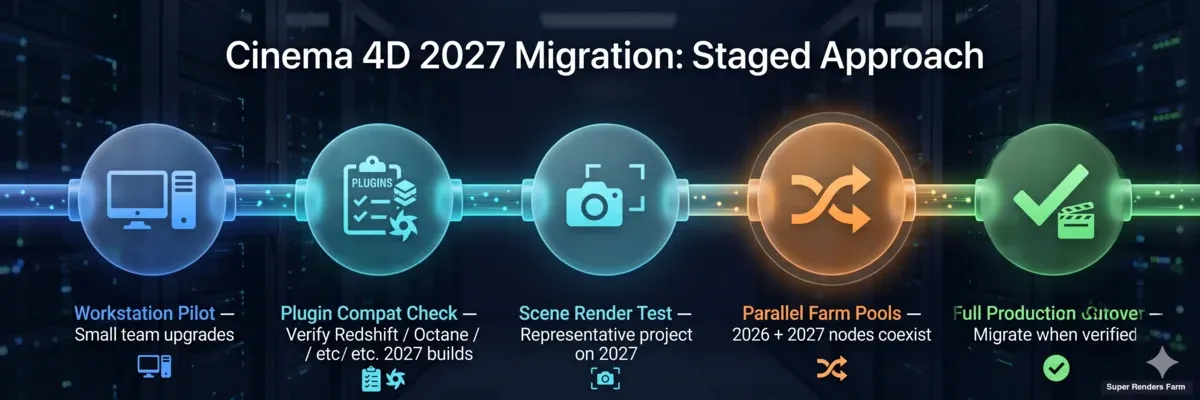
Cinema 4D 2026 to 2027 migration staged approach — workstation pilot, plugin compatibility check, scene render test, parallel farm pools, full production cutover
Cloud rendering implications
As an official Maxon partner, our farm supports Cinema 4D and Redshift workflows under a render-only utilization license. That positioning has practical implications for how Cinema 4D 2027 reaches production on a render farm.
Our render-only license means that when a stable Cinema 4D 2027 release ships and a 2027-compatible Redshift build is available, we install the new version on farm nodes for rendering purposes — not for seat-licensed workstation use. Studios continue to manage their own workstation licenses through Maxon. From a job submission perspective, the migration is straightforward: scenes saved in Cinema 4D 2027 format will be submitted to 2027-equipped nodes; older scenes continue rendering on 2026 nodes during the parallel-pool transition.
We expect to publish 2027-compatible render farm support within the typical four-to-eight-week window after Maxon's stable release. Studios on tight production timelines should plan to test their pipelines on 2027 nodes during the first month after launch, then move full production over once they've validated render output consistency, plugin compatibility, and asset path resolution.
For Cinema 4D rendering on our farm today, see Cinema 4D cloud rendering and our Cinema 4D and Redshift render farm guide.
FAQ
Q: When will Cinema 4D 2027 be released? A: Maxon has not officially announced Cinema 4D 2027 as of mid-May 2026. Based on Maxon's annual release pattern — Cinema 4D 2025 shipped on September 10, 2024, and Cinema 4D 2026 shipped on September 10, 2025 — the most likely release window is September 2026. The official date and feature list will be published by Maxon closer to that window.
Q: What features will Cinema 4D 2027 include? A: Maxon has not published a Cinema 4D 2027 feature list. Based on the 2026 release cycle's engineering focus, likely areas of continued development include Redshift Live (which replaced Redshift RT in 2026.2), physics-driven modeling tools like Fabric Brush, Pyro and volumetric simulation stability, MoGraph and Cloner refinements, OpenUSD library updates, and ACEScg color pipeline maturity. The official feature list will be announced by Maxon in the 2027 release notes.
Q: Will Redshift work with Cinema 4D 2027 at launch? A: A Redshift build compiled for Cinema 4D 2026 will not load in 2027. Maxon will need to release a 2027-compatible Redshift build, and based on historical patterns this typically follows the Cinema 4D release by one to three months. Studios planning Redshift production work on Cinema 4D 2027 should plan to keep Cinema 4D 2026 available for parallel use during the transition.
Q: How does Cinema 4D 2027 compare to Cinema 4D 2026? A: Until Maxon publishes the 2027 release notes, a direct comparison is not possible. What is known is that Cinema 4D 2026 added ACEScg as the default working color space, introduced Redshift Live to replace Redshift RT, shipped the Fabric Brush physics-driven modeling tool, added ARM-native support on Windows, and improved Pyro stability. Cinema 4D 2027 will inherit all of this and add its own features in the September 2026 release.
Q: Will Cinema 4D for iPad ship alongside Cinema 4D 2027? A: Maxon confirmed at NAB 2026 that Cinema 4D for iPad will have a commercial release in "late 2026." The iPad version requires an M2 iPad or newer, with M3 recommended. The exact release date and its alignment with Cinema 4D 2027 desktop have not been announced. The iPad release is a separate product line but is expected to share scene compatibility with the desktop version.
Q: Should studios upgrade workstations to Cinema 4D 2027 immediately at launch? A: A staged approach is the standard recommendation. Upgrade a small number of artist workstations first, test representative project files for two to three weeks, verify that all plugins and renderers used in the pipeline have 2027-compatible builds, and only then expand the upgrade across the full studio. Render farms should follow a parallel-pool transition: maintain 2026-equipped nodes while 2027 nodes come online, then migrate full production once compatibility is verified.
Q: Can a render farm process Cinema 4D 2027 scenes immediately after launch? A: Render farms typically need four to eight weeks after a stable Cinema 4D release before publishing 2027-compatible node support. The constraint is twofold: the farm needs to install and validate the new Cinema 4D version, and the third-party renderers used (Redshift, Octane, Arnold for Cinema 4D) need 2027-compatible builds before they will load. Studios should coordinate with their render farm provider on the timeline for 2027 node availability.
Moving forward with Cinema 4D 2027
The honest summary is that Cinema 4D 2027 is, as of this writing, a pattern of expectations rather than a feature list. The pattern is grounded: Maxon's release cadence has been stable for years, the 2026 cycle's engineering focus is visible in the release notes, and the public roadmap items from NAB 2026 are confirmed. What's not confirmed is the specific feature set that will land in September 2026.
For studios planning Q3 and Q4 2026 pipelines, the practical takeaways are: assume a September 2026 release window, plan for a four-to-eight-week renderer compatibility lag before Cinema 4D 2027 is production-ready for Redshift or other engines, expect Redshift Live and physics-driven modeling tools to continue maturing, and coordinate render farm migration on a parallel-pool basis rather than a hard cutover.
We will update this article once Maxon publishes the official Cinema 4D 2027 release notes, with confirmed features replacing the roadmap signals described here.
Related reading on our farm's Cinema 4D and Redshift workflows:
- Cinema 4D cloud rendering
- Cinema 4D and Redshift render farm guide
- What's New in Cinema 4D 2026: Full-Year Feature Recap
- What's New in 3ds Max 2027
- What's New in Maya 2027
For more on Cinema 4D itself, see Maxon's Cinema 4D product page and the Cinema 4D 2026.2 release notes.
About Alice Harper
Blender and V-Ray specialist. Passionate about optimizing render workflows, sharing tips, and educating the 3D community to achieve photorealistic results faster.